AI · 5 min read · November 2026
What the EU AI Act changes for your chatbot
One thing above all: visitors must know they are talking to an AI. The rule has applied since 2 August 2026.
 Edmond JreigeANEDA
The short answer
One thing above all: visitors must know they are talking to an AI, unless it is obvious. The transparency rules of the EU AI Act apply from 2 August 2026. GDPR still applies to everything visitors type into the chat.
Which part of the AI Act concerns a website chatbot?
Most of the AI Act deals with high-risk systems, such as AI used in hiring, credit or critical infrastructure. Few companies run those. Article 50 is different: it sets transparency obligations for common uses, including AI systems that interact directly with people.
A chatbot on your website is exactly that. So is an AI assistant that answers your clients by email or in a messaging app.
What does the transparency rule ask?
The principle is simple: people must be informed that they are interacting with an AI system, unless this is obvious from the context. The Act also covers content generated by AI:
- Conversations. People should know from the start that they are not talking to a person.
- Images, audio and video. Content that is artificially generated or manipulated and could pass for real must be disclosed as such.
- Text published to inform the public. AI-generated text on matters of public interest must be disclosed, unless a person has reviewed it and takes editorial responsibility.
The obligations apply from 2 August 2026.
What should you check on your site?
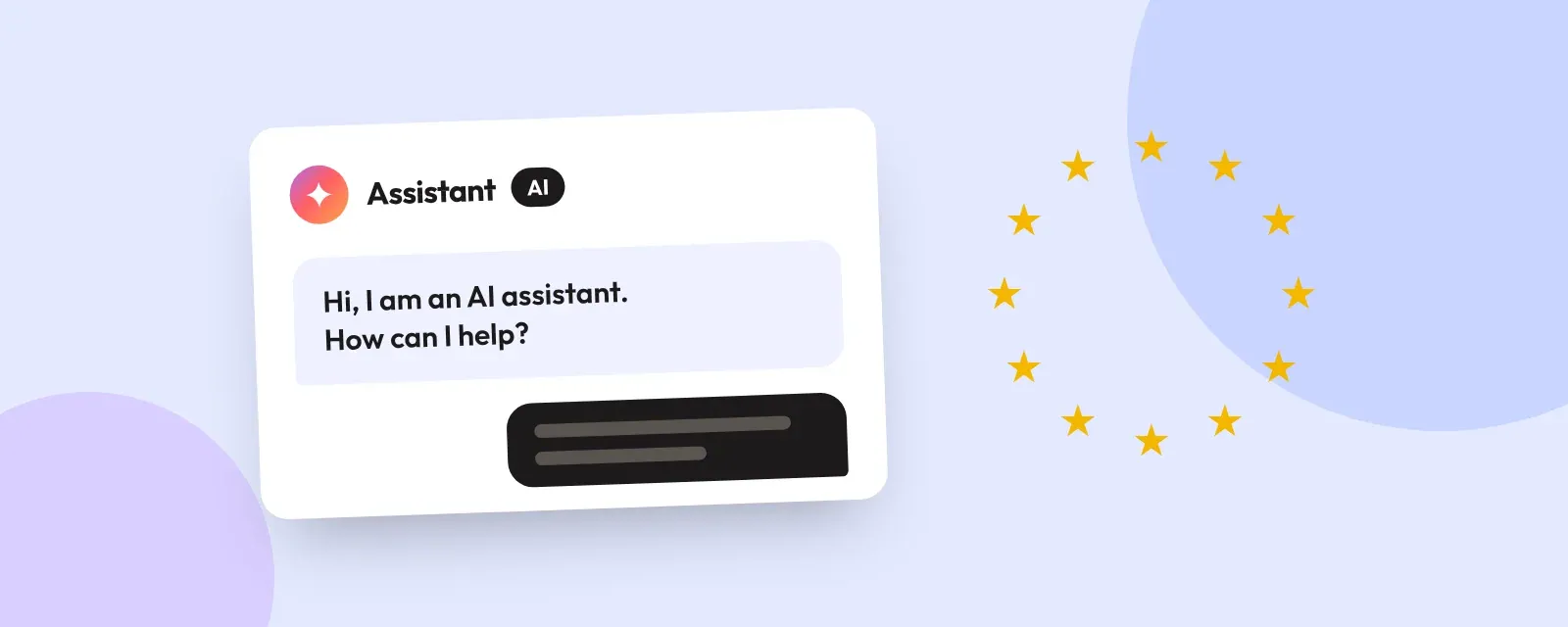
- The chat says it is an AI, in its title or in its first message.
- The assistant does not pose as an employee. No human name and photo that suggest a real colleague.
- A person is reachable. The visitor can see how to contact your team, and the assistant hands over when it cannot help.
- Generated visuals are labelled when they could be mistaken for real photos or videos.
- The privacy notice covers the chat: what is stored, for how long, and which provider processes it.
Are you a provider or a deployer?
The Act distinguishes two roles, and they do not carry the same obligations:
| Role | Who it is | Typical case |
|---|---|---|
| Provider | Develops an AI system and places it on the market | A company that builds its own assistant and offers it to others |
| Deployer | Uses an AI system in its own activity | A company that installs a chatbot from a vendor on its website |
Most companies with a website chatbot are deployers. Building or heavily adapting your own system can make you a provider. If you are unsure which you are, ask before launch, not after.
What does not change?
GDPR applies as before. Everything a visitor types into the chat may contain personal data: names, email addresses, sometimes more than they should share. Check:
- Where the conversations are stored, and for how long.
- Whether the provider uses them to train its models.
- Whether data leaves the European Union.
- Who in your team can read the conversations.
If the assistant is supplied by a vendor, these answers are in its contract and its documentation. Read them before you switch it on.
How should the assistant behave?
The law sets a minimum. A good assistant goes further:
- It answers from your own content, and says when it does not know.
- It shows where an answer comes from, with a link to the page.
- It does not promise prices, deadlines or legal positions it cannot guarantee.
- It hands over to a person at the right moment, with the conversation attached.
Visitors who discover halfway through a conversation that they were talking to a machine feel deceived. A bot that says what it is, shows its sources and passes the conversation on is simply a better product.
What should you do this month?
- List every place where an AI talks to clients or produces content you publish.
- Check each one against the five points above.
- Fix the wording of the chat window and the privacy notice.
- Note who is responsible for each system, and whether you are its provider or its deployer.
What about an assistant inside your product?
The same transparency rule applies when an AI talks to users inside an app or a client area. Say it in the interface, where the conversation starts. If the assistant takes actions for the user, such as booking, ordering or changing data, show what it is about to do and let the user confirm.
What about AI-written content on your blog?
Articles written with AI help are common. The Act asks for disclosure when AI-generated text is published to inform the public on matters of public interest, unless a person has reviewed it and takes editorial responsibility. For a company blog, the simplest rule is the honest one: a named person reviews and signs what you publish.
Which mistakes should you avoid?
- Giving the bot a human name and face "to make it friendlier".
- Hiding the hand-over to a person behind several screens.
- Letting the assistant answer from the open web instead of your own content.
- Switching on a vendor’s chatbot without reading where the data goes.
Does this apply if your company is outside the EU?
The Act looks at where the system is used, not only where the company is based. If your chatbot talks to people in the European Union, plan as if the transparency rule applies to you, and ask your lawyer to confirm the details for your case.
This article is a summary, not legal advice. For your specific case, check with your lawyer or data protection officer. For the design side, see our guide The AI-ready website and our chatbots & assistants service.