AI · 5 min read · November 2026
Which task should an SME automate first?
The one that is frequent, follows rules, carries little risk and is easy to check. Usually it is a reply your team writes ten times a week.
 Edmond JreigeANEDA
The short answer
Pick a task that is frequent, follows rules, carries little risk and is easy to check. In most small companies, that is a reply or a document your team writes again and again. Run it as a 30-day pilot with a person approving every result.
Why start with one task?
Most companies that stall with AI started with a plan for the whole business. The ones that get a result start with one task, run it for a month and measure it.
- It is cheap to try. One task needs one tool, one prompt and one person to check.
- It is easy to explain. The team sees exactly what changes in their week.
- It is easy to stop. If it does not work, you drop it without a write-off.
A strategy comes later, built on what the first tasks taught you.
How do you find the right candidate?
Ask each person in the team for the three tasks they would happily never do again. Write them all on one list, with how often each one happens. Then put every task through four questions.
1. Is it frequent?
Something done every day pays back faster than something done once a quarter. Frequency is also what makes a pilot measurable: in 30 days you see enough cases to judge.
2. Does it follow rules?
If a new colleague could do it from a one-page instruction, an assistant can draft it. If it depends on judgement nobody has written down, write the rules first. That exercise alone often saves time.
3. Is the risk low?
A wrong draft of a quote reply is caught before it leaves. A wrong payment, a wrong legal clause or a message sent to the wrong client is not. Start where the worst case is a draft that needs rewriting.
4. Is it easy to review?
A person must be able to check the result in seconds. If checking takes as long as doing, nothing is saved.
The task that passes all four is your first candidate. If two are level, take the one that eats the most hours.
Which tasks usually win?
In small and mid-sized companies, the same candidates come back:
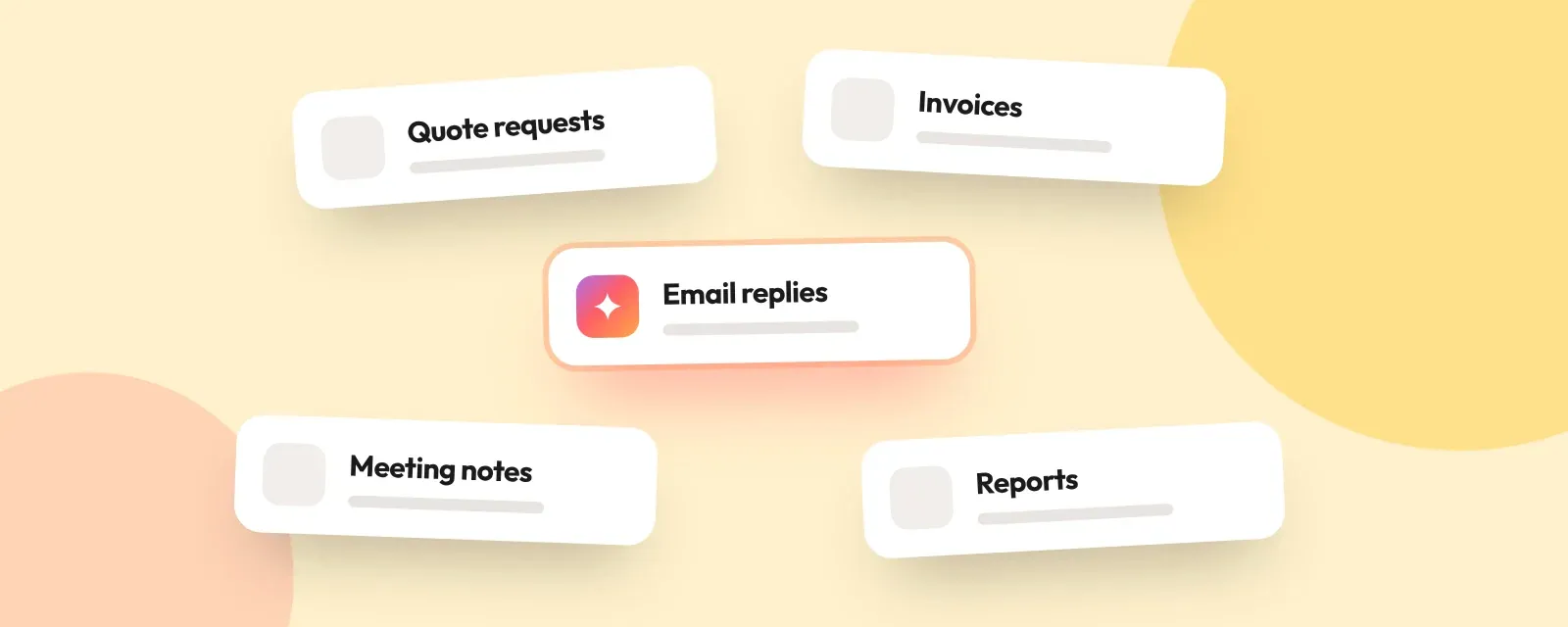
- First replies to quote requests, drafted from the request and your price rules, then checked by a person.
- Answers to recurring client questions, built from your own documents rather than the open web.
- Meeting notes turned into actions, with owners and dates.
- Data copied from documents into a system: invoices, forms, delivery notes.
- First drafts of routine documents: offers, reports, summaries for a manager.
None is spectacular. All are done every week by people who would rather do something else.
What should you leave for later?
Anything where a mistake is expensive or hard to see:
- Pricing decisions and discounts.
- Legal texts and contracts.
- Messages that leave the company without a person reading them.
- Anything that touches personal data you are not sure you may process.
These are not forbidden forever. They need more preparation, and a first success makes that preparation easier to justify.
How do you run the pilot?
- Measure today. Note how long the task takes and how often it happens, for one or two weeks.
- Write the instruction. One page: what the input is, what a good result looks like, what must never happen.
- Set up the tool. Start with the simplest one that keeps your data where it should be.
- Keep a person in the loop. The assistant drafts, a person approves. Nothing leaves on its own.
- Compare after 30 days. Time spent, number of corrections, and what the team thinks.
If the time saved is real, keep it and pick the next task from the list. If not, you have lost a month, not a budget.
What about data and the law?
Before the pilot, check three things with whoever handles data protection in your company:
- Which data the task uses, and whether it includes personal data.
- Where the tool processes and stores that data, and whether it is used to train models.
- Who has access to the inputs and the results.
If the assistant talks to clients directly, the EU AI Act also asks you to tell them they are talking to an AI. For an internal draft that a person approves, that question does not arise.
What does success look like?
Not a dashboard. A team that spends less time on the task, a result of the same quality, and a second task already on the list. Most companies that get there move faster on the next ones, because the method is the same each time.
Which tools do you need?
Fewer than you think. For a first task, three options cover most cases:
- A general assistant with a business plan that keeps your data out of training, for drafting and summarising.
- The AI features of tools you already pay for: your mailbox, your CRM, your document suite.
- A small automation that connects two tools, when the task moves data from one place to another.
Start with what your team already knows. A new tool is a second project hidden inside the first.
Which mistakes should you avoid?
- Automating a broken process. If the task is badly defined today, AI will do it badly faster.
- Skipping the measurement. Without the "before", nobody can say whether the pilot worked.
- Removing the person too early. Keep the approval step until the corrections become rare.
- Choosing the most impressive task instead of the most frequent one.
Our free guide AI in your company: the first task to automate has the scoring worksheet and ten tasks to choose from. To do it with us, see the AI audit & workshop.