SEO · 5 min read · November 2026
How to get your company quoted by ChatGPT
Let its search crawler in, answer real questions in plain sentences, and make sure the rest of the web says the same thing about you.
 Edmond JreigeANEDA
The short answer
Let the assistants’ search crawlers read your site, put real answers in plain text on your pages, and make sure the rest of the web describes your company the same way. Then check every month who gets quoted.
How does an assistant pick its sources?
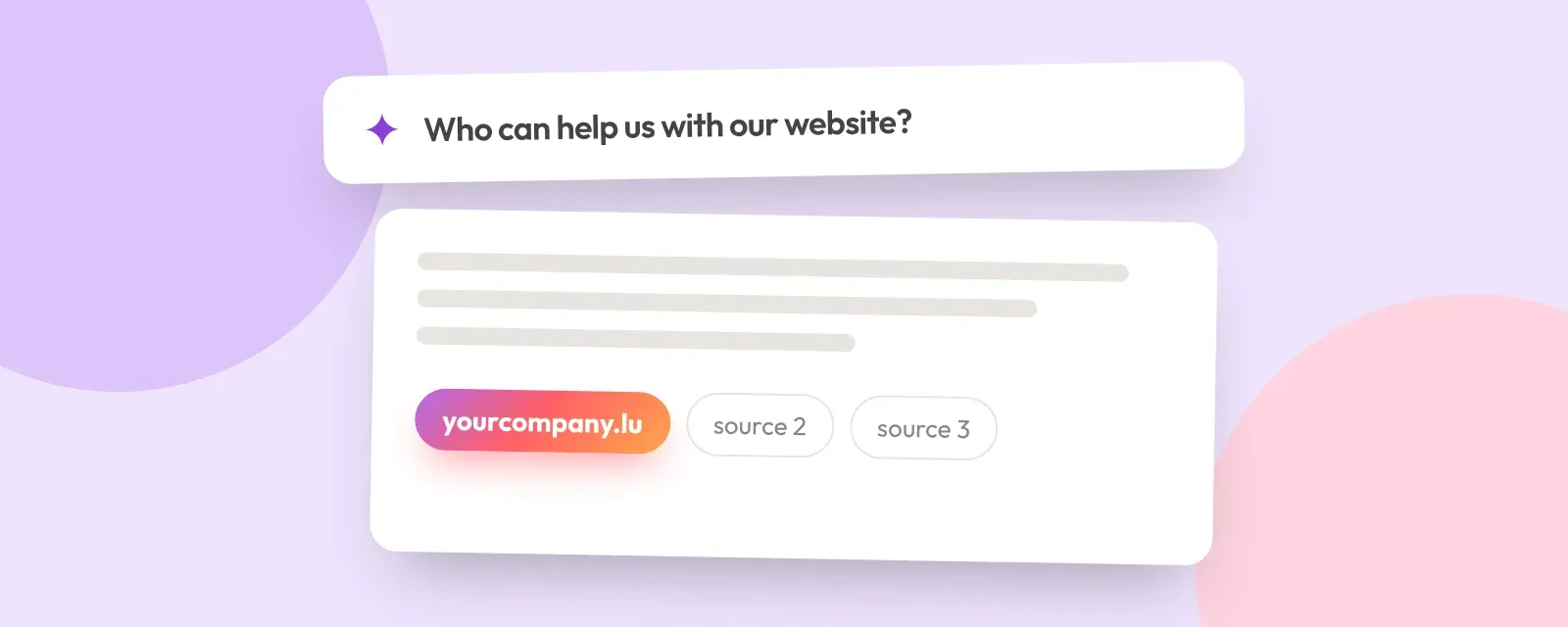
When a question needs fresh information, assistants such as ChatGPT, Claude, Perplexity or Copilot search the web, open a few pages and write an answer with links. To be one of those links, your page has to pass three steps:
- Be found. The assistant’s crawler or search index must be able to reach it.
- Be read. The text must be in the page, not hidden in scripts, images or PDFs.
- Be worth quoting. The page must contain a clear sentence that answers the question.
Most companies fail at the first or second step without knowing it.
Step 1: are the right crawlers allowed in?
AI companies run separate crawlers for separate jobs. OpenAI, for example, uses OAI-SearchBot for the results shown in ChatGPT search and GPTBot to collect content for training. Its documentation says a site that blocks OAI-SearchBot will not be shown in search answers.
You can allow search and refuse training, in your robots.txt. Check three things:
- robots.txt allows the search crawlers you want to appear in.
- Your firewall or CDN does not block AI crawlers before they even read robots.txt. Some security settings do this by default.
- Bing Webmaster Tools. Several assistants rely on Bing’s index, so register your site there as well as in Google Search Console.
Step 2: can a machine read your pages?
Many crawlers do not run scripts. If your content only appears after JavaScript runs, or sits inside images, sliders and PDFs, they see an empty page. Ask your developer to look at the page source, not the page in a browser. The words should be there.
Then check the basics:
- One clear title per page, and headings that describe the sections.
- Your company name, address and contact details in text, on every page.
- Structured data describing your organisation, your services and your articles.
- Fast pages. Slow ones are crawled less.
Step 3: do your pages answer real questions?
Assistants quote sentences that answer the question asked. Marketing copy rarely does. Take the questions clients ask before they hire you, and give each one a page or a section:
- Use the question as the heading.
- Answer it in the first two sentences, plainly.
- Then give the detail: steps, conditions, examples.
- State facts: what you do, for whom, where, how long it takes.
Compare "We craft bespoke digital experiences" with "We design and build multilingual company websites in Luxembourg, usually in four to eight weeks". Only the second can be quoted.
Step 4: does the rest of the web agree?
Assistants cross-check. A company described the same way on its own site, in directories, on client sites and in the press is easier to trust than one that only exists on its own pages.
- Use the same name, address and description everywhere.
- Keep your Google Business Profile and the main directories of your market up to date.
- Ask clients whose sites mention you to link to you with an accurate description.
- Publish case studies with the client’s agreement: they are proof that others can cite.
What about llms.txt?
llms.txt is a proposed file that lists the pages a language model should read first. It is cheap to add and does no harm. But it is a proposal, not a standard, and the main assistants do not say they rely on it. Do the four steps above first.
How do you know if it works?
There is no full report yet. Use three signals:
- Ask the assistants. Once a month, ask two or three of them the questions your clients ask, and note who is quoted.
- Watch your analytics. Visits from chatgpt.com, perplexity.ai and similar sources show up as referrals.
- Ask new clients. "How did you find us?" now has a new answer.
It is a rough measure, but it is the one your clients see.
Which pages should you write first?
Start with the questions closest to a decision. For most companies, they are:
- What exactly do you do, and for whom?
- How does working with you run, step by step?
- How long does it take?
- What does it depend on, and what affects the cost?
- How do you compare with the alternatives your clients consider?
Each answer becomes a page or a section. They help human visitors as much as assistants: the people who read them are the ones close to contacting you.
Which mistakes should you avoid?
- Blocking every AI crawler "to be safe", and disappearing from AI search with them.
- Hiding key information in PDFs and images.
- Writing slogans instead of facts.
- Describing the company differently on every platform.
How long before it shows?
Assistants that search the web can pick up a new page as soon as their crawler reads it. What they say about your company in general changes more slowly, as other sites start to describe you. Treat it like SEO: steady work over months, not a switch you flip once.
The full method, with a checklist for your agency, is in our guide The AI-ready website. To have it done, see SEO & AI visibility.